My Tour Guide Journey: Part 12 – “Geneva Guides Association”
After successfully completing the Culture and Tourism program at the University of Geneva and receiving my diploma, I’m delighted to take the next step in my journey: becoming a Geneva professional tour guide! The studying, exams, and field trips are behind me. Now comes the exciting part: sharing Geneva’s fascinating history, architecture, culture, and hidden gems with visitors from around the world.
Geneva Walking Tours in English, French, and Spanish
My goal is to offer private and group tours in English, French, and Spanish, introducing visitors to the city’s historic landmarks, beautiful parks, and lesser-known treasures. As an English mother tongue tour guide, I expect to conduct many of my Geneva guided tours in English, while also welcoming French- and Spanish-speaking visitors, travelers from elsewhere in Switzerland, and Geneva residents looking to discover their city from a fresh perspective.
Joining the Geneva Guides Association
My University of Geneva diploma is more than a personal achievement. It has also opened doors to new professional opportunities, including membership in the Association des Guides de Genève (Geneva Guides Association) and the possibility of becoming a certified guide for the Fondation Genève Tourisme et Congrès (Geneva Tourism and Congress Foundation).
After contacting both organizations to express my interest, I received some exciting news: my application to the Association des Guides de Genève was accepted, along with an invitation to its annual Escalade dinner on December 10! For a newly qualified Geneva professional tour guide, this was a wonderful opportunity to meet experienced guides and celebrate one of Geneva’s most beloved traditions.
An Escalade Dinner in Geneva’s Old Town
The dinner took place at the Brasserie Restaurant Hôtel de Ville, right in the heart of Geneva’s charming Old Town. Over a delicious Swiss meal and local wine, I enjoyed lively conversations and met many of my new colleagues. Before dinner, the association shared news and updates, and I was introduced as a new member. To my great delight, I also received my official Geneva Guides Association badge—a special milestone after all the studying and preparation!
The evening continued with readings of poetry and historical texts about the Escalade of December 11–12, 1602, when the Duke of Savoy’s troops attempted to invade Geneva under cover of darkness. The attack failed, and Geneva defended its independence. Today, the Escalade is celebrated throughout Geneva with historical commemorations, festive events, and traditional treats. For Geneva tour guides, it’s a wonderful opportunity to bring this dramatic chapter of the city’s history to life. And, of course, no Escalade celebration would be complete without chocolate!
The Escalade’s Sweetest Tradition
One of the Escalade’s best-known traditions is the marmite: a chocolate cauldron filled with marzipan vegetables and candies. It commemorates the story of Catherine Cheynel, known as Mère Royaume, who is said to have poured a pot of hot soup over an enemy soldier during the invasion. Tradition dictates that the oldest and youngest people present break the chocolate cauldron together while everyone chants: « Ainsi périssent les ennemis de la République ! »(“Thus perish the enemies of the Republic!”)
Naturally, we followed the tradition at our dinner. The cauldron was ceremoniously broken, the famous words were proclaimed, and everyone enjoyed the chocolate and marzipan treats. History has rarely tasted so good!
New Colleagues, New Friends, and New Adventures
It was a lovely evening filled with good food, fascinating conversations, and celebration. I left with my new association badge and, more importantly, a wonderful group of professional tour-guide colleagues and friends. Joining the Association des Guides de Genève marks another exciting milestone in my journey as a Geneva professional tour guide. I look forward to learning from fellow guides and sharing Geneva’s remarkable stories with visitors from around the world.
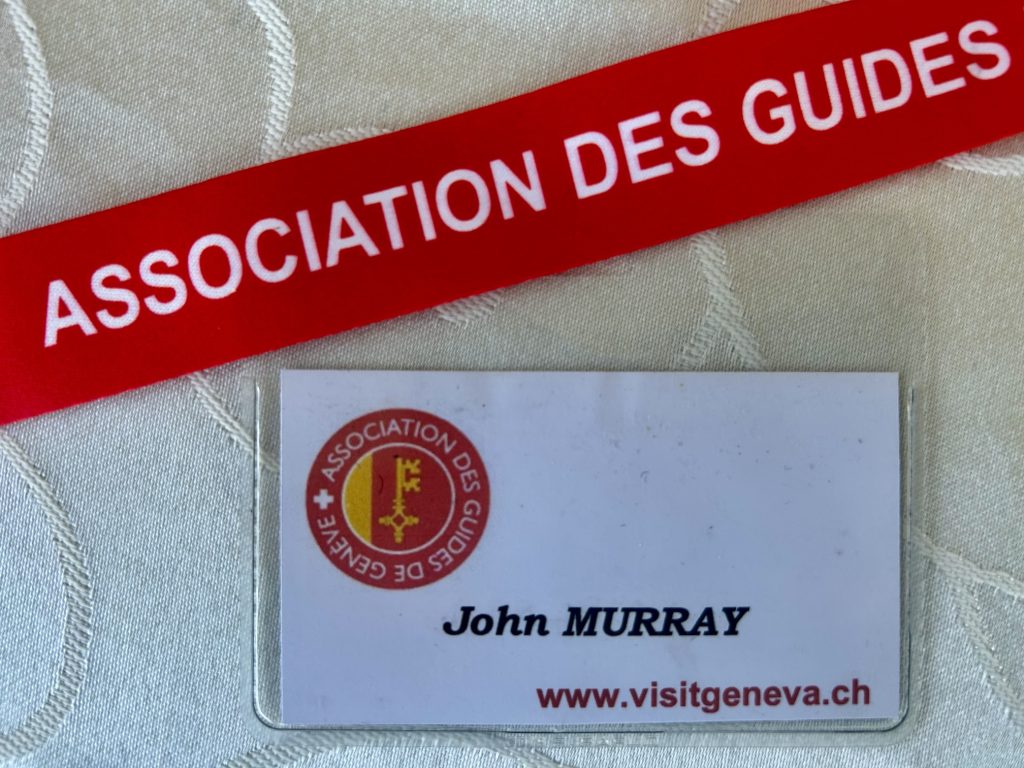
My Geneva Guides Association badge
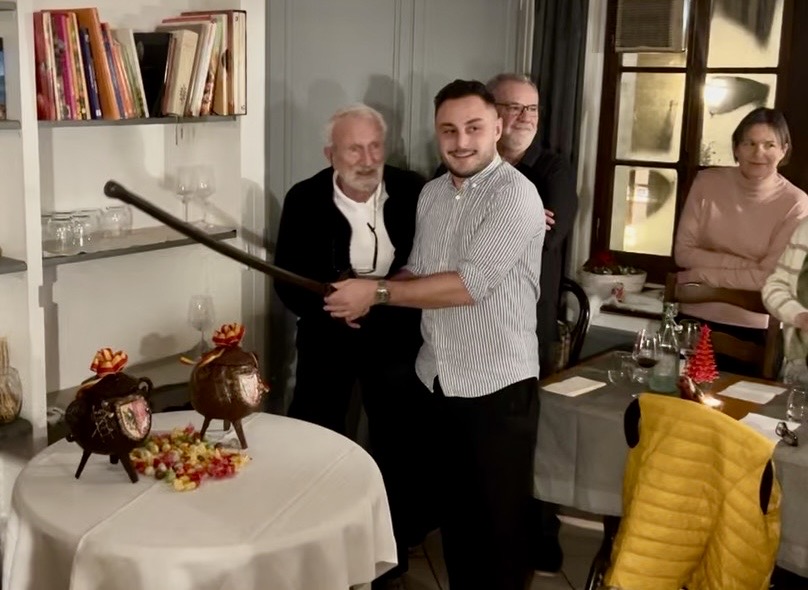
Breaking the marmite, GGA annual Escalade Dinner
After more than a year of study, field trips, presentations, exams, and countless unforgettable experiences, my Culture and Tourism course at the University of Geneva has officially come to an end. It has been an incredibly rewarding journey, and I am proud to have completed the program with distinction. The final milestone was receiving my diploma during the graduation ceremony held at the University of Geneva’s UNIMail Campus—a memorable moment that marked the beginning of a new chapter in my career as a professional tour guide in Geneva.
The graduation ceremony began with an inspiring lecture by Leïla el-Wakil, a renowned Geneva architect, architectural historian, and former associate professor at the University of Geneva. Her fascinating presentation explored the use of iron and decorative metalwork in Geneva’s architectural heritage, highlighting many beautiful details that often go unnoticed while walking through the city. It was a fitting topic for students who had spent the past year discovering the rich history, architecture, and cultural heritage of Geneva.
Following the lecture, each graduate was invited to receive their diploma and briefly present their final project. My project, “The Lakeside Villas, Gardens and Art of Geneva’s Right Bank,” focused on one of my favorite areas of the city. I explained that I chose this theme because of my passion for historic architecture, landscaped gardens, and public parks. These interests have inspired several of my Geneva walking tours, allowing visitors to discover a quieter and often overlooked side of the city beyond its most famous landmarks.
I was also pleased to share that I am already developing a companion project exploring the villas, gardens, and public art of Geneva’s Left Bank. Geneva is full of remarkable stories waiting to be discovered, and I look forward to continuing my research to create new and engaging walking tours in Geneva.
After the diploma ceremony, our class gathered with family, friends, professors, and fellow graduates to celebrate over food and drinks. It was a wonderful opportunity to reflect on everything we had learned together and to celebrate both the end of an incredible academic experience and the beginning of our careers as professional Geneva tour guides.
Although it was a little bittersweet to say goodbye to such an enjoyable course, I leave with a deep appreciation for everything I learned at the University of Geneva. The knowledge, practical experience, and friendships I gained throughout the program have strengthened my passion for sharing the history, architecture, and culture of this remarkable city.
Today, I am excited to put that knowledge into practice by offering Geneva walking tours that combine historical insight, architectural discovery, and local stories. Whether you’re visiting Geneva for the first time or returning to explore it in greater depth, I look forward to welcoming you on a walking tour and sharing the city that has become my home and my passion.

Receiving my diploma from the University of Geneva

My graduation speech

The Culture and Tourism class of 2025
My course in Culture and Tourism at the University of Geneva has officially come to an end. Recently, I delivered the oral presentation and guided tour for my final project, titled “The Lakeside Villas, Gardens and Art of Geneva’s Right Bank.”
The final project involved creating a two-hour thematic walking tour focused on a specific area and subject within Geneva. I chose the villas, gardens, and public art of Geneva’s Right Bank because these beautiful lakeside parks are located close to where I live and are places that I have enjoyed visiting for many years. The tour takes visitors through five public parks: Parc Mon Repos, Parc Moynier, Parc Perle du Lac, Parc Barton, and Parc William Rappard.
Over the years, I had already done some basic research on a few of the historic villas and the history of these parks. When the opportunity arose to create my own tour, I was excited to dive much deeper into the subject and develop an engaging experience that I could share with both tourists and local residents. My goal was to create one of those memorable Geneva walking tours that reveals a side of the city many people overlook.
The first phase of the project consisted of a 30-page written report describing the tour in detail. This included historical research, explanations of the points of interest, references, photographs, and a complete itinerary. After submitting the written portion in June, I was delighted to receive a high mark along with very positive comments from the professor.
The second phase was even more exciting—and a little more nerve-racking. I had to lead a one-hour guided tour for my professors, classmates, and a jury composed of professional Geneva tour guides. The evaluation focused on many of the key skills required of a Geneva professional tour guide, including voice projection, storytelling ability, logical structure, body language, historical accuracy, audience interaction, timing, and visitor safety. To add an extra challenge, the entire presentation had to be delivered in French.
Although I was somewhat nervous before the exam, I felt well prepared. During the previous month, I had practiced the tour several times with friends and family. Fortunately, the weather on the day of the exam was absolutely beautiful, which certainly helped.
At 1:00 p.m., I met the professors, jury members, and several classmates at the starting point in Parc Mon Repos, and we set off on the tour. Everything flowed smoothly from one stop to the next. When the jury asked difficult questions, I was able to answer confidently and accurately. Before I knew it, the hour had flown by. As we concluded the tour in front of the WTO building in Parc Rappard, I felt an enormous sense of relief as the group applauded with smiles on their faces.
A few days later, I received my final grade: 5.75 out of 6 !
I couldn’t have been happier.
Not only did this mark provide a wonderful conclusion to the course, but it also means that I now have my own original thematic tour—“The Lakeside Villas, Gardens and Art of Geneva’s Right Bank”—which I can offer as part of my Geneva guided tours and Geneva private guided tours.
All of the hard work, research, preparation, and practice have paid off. The only step remaining is to receive my diploma at the graduation ceremony in November and officially launch my activity as a Geneva professional tour guide.
I look forward to sharing this unique tour, along with other Geneva walking tours, with future visitors who want to discover the rich history, culture, gardens, architecture, and hidden stories of this remarkable city.
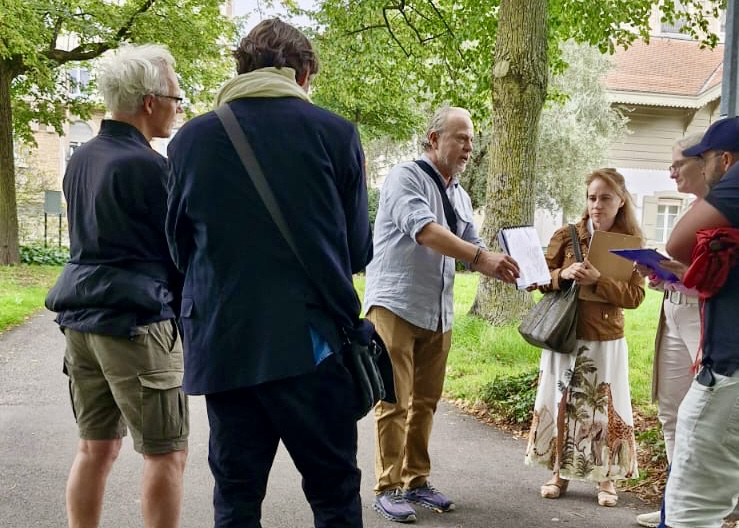
Presentation of my final project walking tour to professors, jury and classmates
This summer has been an important milestone in my journey as a Geneva professional tour guide. Over the past several months, I have been preparing and practicing the one-hour walking tour that I created as the final project for my Culture and Tourism course at the University of Geneva. Since the final exam will be conducted in French, I spent countless hours refining both the content and my presentation skills.
While I have already led several Geneva walking tours for family and friends, most have been in English. But recently, an unexpected opportunity arose. A friend asked if I would conduct a guided tour in French for a group of visitors from Paris who were coming to Geneva for the first time. I immediately accepted and was excited to put my preparation into practice, especially in French.
The group consisted of six adults and three young children. Before the tour began, the parents asked if we could follow a route that included places where the children could take breaks and play. One of the most important skills of a professional guide is adapting to the needs of clients, so I happily redesigned the itinerary.
Instead of beginning in the Jardin Anglais as I normally do on my Geneva guided tours, I started in Parc des Bastions. The large open spaces allowed the children to run around while I introduced the adults to the history of the Reformation Wall. I also promised the children a special surprise at the end of the tour, which immediately captured their attention.
Our next stop was La Treille, where there is a playground and perfect place to provide another break for the children while the parents enjoyed the historical commentary. We then visited the Old Armory, where the cannons proved to be a favorite attraction and the children had the opportunity to climb on them. After passing through the Old Town and St. Pierre Cathedral, we descended through the picturesque Passage des Degrés-de-Poules to Place du Bourg-de-Four and spoke about the centuries and millenniums of history there. Finally, the big highlight for the children came at Place de la Madeleine, where the promised surprise awaited: ice cream and a carousel ride. While they enjoyed themselves, I introduced their parents to the square’s points of interest, including the Water Ring fountain by Swiss artist Gérard Ducimetière, the Temple de la Madeleine, and Geneva’s historic civil defense shelter.
From there, we continued to the lakefront via Place Longemalle to admire the Flower Clock and the Jet d’Eau. The tour ended on a beautiful summer afternoon with smiles from both the parents and the children.
Most importantly, conducting the entire tour in French was a success. It confirmed that all the effort I had invested in my studies and preparation had paid off and gave me the confidence I needed for my upcoming oral examination. It was also an important step toward offering Geneva guided tours in French and Geneva private guided tours to a wider international audience.
Looking back, this first experience as a French-speaking professional tour guide in Geneva was one of the most rewarding moments of my tour guide journey.
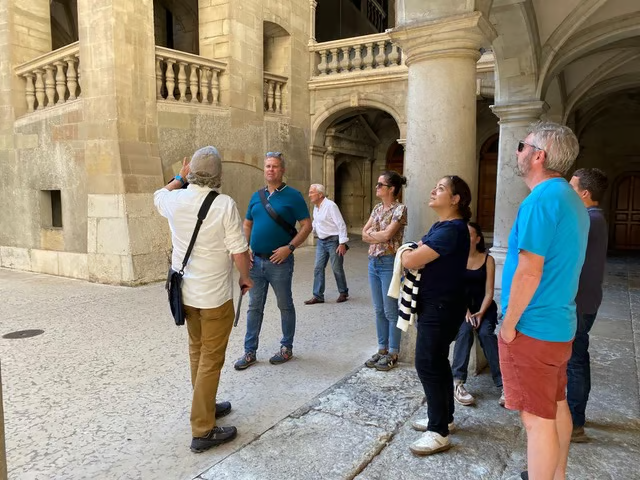
My first Tour de Ville in French
My Culture and Tourism course at the University of Geneva is quickly coming to an end, and it has been an exciting journey from the classroom to real-life experience. While preparing for final exams and working on my final project, I’ve also had the opportunity to give a few private Geneva guided tours to family and friends visiting from abroad. It has been incredibly rewarding to put everything I’ve learned into practice and continue developing my skills as a Geneva professional tour guide.
Recently, my cousins Ellen, Tom, Kathy, and Alex visited from the US during their trip through France, Switzerland, and Austria. Since it was their first time in Geneva, it was the perfect chance to introduce them to the city’s history, cultures, hidden gems, and beautiful lakeside atmosphere through a relaxed style of slow travel.
On their first full day, we set out on one of my favorite Geneva walking tours through the city center. Starting from their hotel in the Paquis, we explored the right-bank lakefront, including the famous Palais Wilson, Bains des Pâquis, Brunswick Monument, and the elegant Belle Époque boats along the waterfront. We crossed the Mont Blanc Bridge and followed the classic “Tour de Ville” route through the Old Town, stopping at landmarks such as the Flower Clock, Place du Bourg-de-Four, and St. Pierre Cathedral. We even made a small detour to admire the beautiful Russian Church in the Trancheés neigborhood.
After several hours of walking and storytelling, we rewarded ourselves with a well-earned beer at La Clémence in the Old Town. Sitting on the terrace, watching the city pass by, felt like the perfect slow travel moment.
The next day, we drove to the charming medieval town of Gruyères to experience more of the Swiss countryside. We wandered through the village streets, visited the quirky HR Giger Museum, and enjoyed a delicious cheese fondue with local white wine on a sunny terrace. With perfect weather and postcard-worthy scenery, it was a fantastic day trip.
On their final day in Geneva, we explored the peaceful lakeside parks of Mon Repos, Moynier, and Perle du Lac before taking the little Mouette boat across the lake. Walking along the quay, we talked about Geneva’s lake culture, the Jura mountains, and the city’s unique blend of international and local life.
After three busy days of sightseeing, we decided it was finally time to slow down completely. We grabbed drinks beside Geneva’s iconic Jet d’Eau and watched the sunset behind the Jura mountains — the perfect ending to a day of slow travel site seeing in Geneva.
In addition to our daytime touring, we also had some lovely evenings together dining at local restaurants Costa Smeralda and Saveurs de Liban, and dinner one night in our home. All in all it was a fabulous visit combining quality family time, Geneva site seeing and dining.
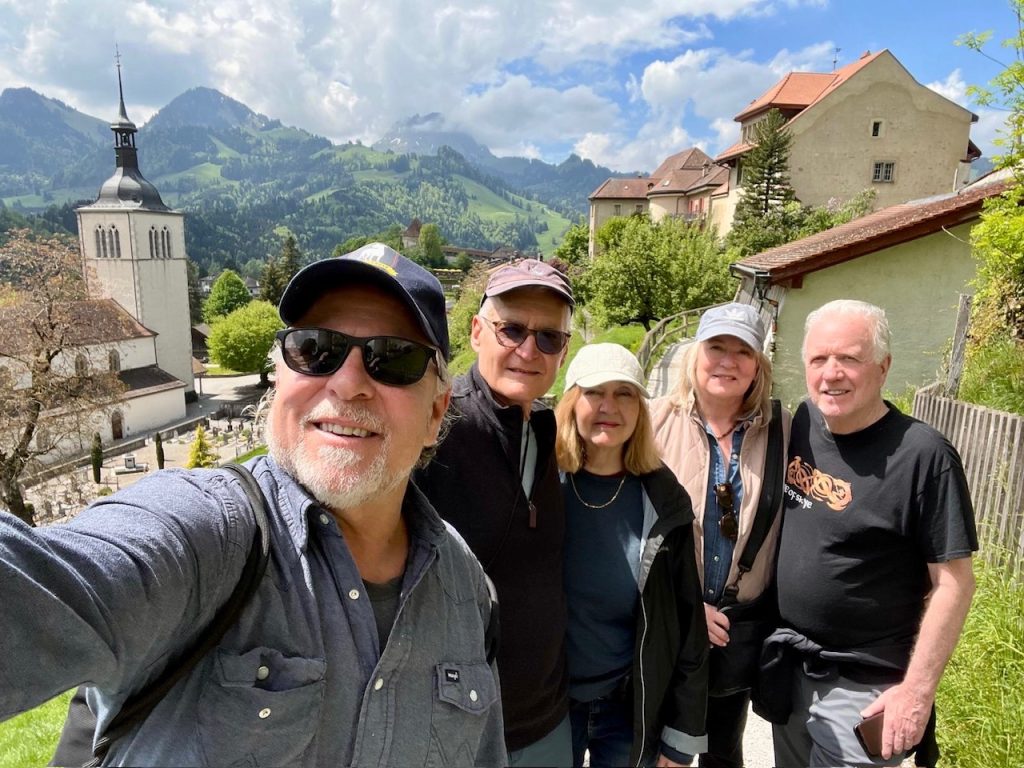
Day trip to Gruyères with my first “customers”
As 2025 unfolds, my Culture and Tourism course at the University of Geneva continues to be both fascinating and inspiring. Through classroom lectures, museum visits, and Geneva walking tours led by some of the city’s most experienced guides, I continue to deepen my understanding of local history, culture, and tourism.
Some of our recent visits have included the Patek Philippe Museum, the Grand Théâtre de Genève, the Conservatoire de Musique de Genève, the Basilica of the Sacred Heart, the Maison de Rousseau et de la Littérature (MRL), the Musée d’Art et d’Histoire, the Musée d’Histoire des Sciences, and several other important cultural sites. These experiences have provided valuable insight into the work of a Geneva professional tour guide and the diverse range of Geneva guided tours available throughout the region.
Last month, our class embarked on our first official excursion beyond Geneva, travelling by bus to several historic and cultural sites in the Canton of Vaud. The program included guided visits to the Château de Chillon and the city of Lausanne. The excursion was not only an opportunity to discover important destinations outside Geneva, but also to experience firsthand how narrated Geneva excursions and Swiss bus tours are conducted by professional guides during the journey itself.
Our guide for the day was Debra Kinson, a highly experienced Geneva professional tour guide who conducts both Geneva walking tours and narrated excursions throughout Switzerland. An interesting fact about Debra is that she is also a graduate of the same Culture and Tourism course that we are currently completing.
Immediately after departing the Geneva Gare Routière, Debra began her onboard narration, sharing fascinating descriptions, historical context, and amusing anecdotes about the buildings, neighborhoods, and landscapes along the route. I was especially impressed by both her depth of knowledge and her warm, humorous demeanor. Listening to her commentary made me realize that providing narration on a moving bus through a microphone system is truly another dimension of professional tour guiding.
Upon arriving at the Château de Chillon, we were escorted from the bus and welcomed into the castle by one of the château’s official guides, dressed in traditional Savoyard period costume. Although I had visited the château several times in the past, experiencing it through the guidance of an expert tour guide revealed many fascinating details that I had never previously noticed. In addition, after recently studying the history of Geneva, the House of Savoy, and the surrounding region, the historical significance of the château made much more sense to me.
After our visit to the Château de Chillon, we continued our journey toward Lausanne along the scenic lakeside route through Montreux, Vevey, and several picturesque villages overlooking Lake Geneva. Throughout the drive, Debra continued her narration, providing many interesting historical and cultural insights about the region visible from the bus windows.
Upon arrival at Lausanne-Ouchy, our class enjoyed lunch together at a local restaurant near the port. After lunch, we were greeted by a local Lausanne guide who led us on a walking tour of the city, including a visit to the magnificent Lausanne Cathedral, also known as the Cathedral of Our Lady of Lausanne. The tour offered a fascinating introduction to the history, architecture, and atmosphere of this beautiful Swiss city.
Our first-class excursion turned out to be a truly memorable experience. Not only did we learn more about important historical sites and the techniques involved in providing onboard narration during Geneva excursions and Swiss guided tours, but the trip also allowed us to strengthen friendships within our class.
During the journey, I sat with two of my closest classmates, Xavier Fernandez and Hansjörg Roth, with whom I have collaborated on several projects throughout the course. All three of us share a passionate interest in history, and we often exchange information, ideas, and book recommendations. Travelling together, discussing the places we visited, and sharing our enthusiasm for history made the experience even more enjoyable.
Overall, the excursion was another meaningful milestone in my ongoing journey toward becoming a Geneva professional tour guide.
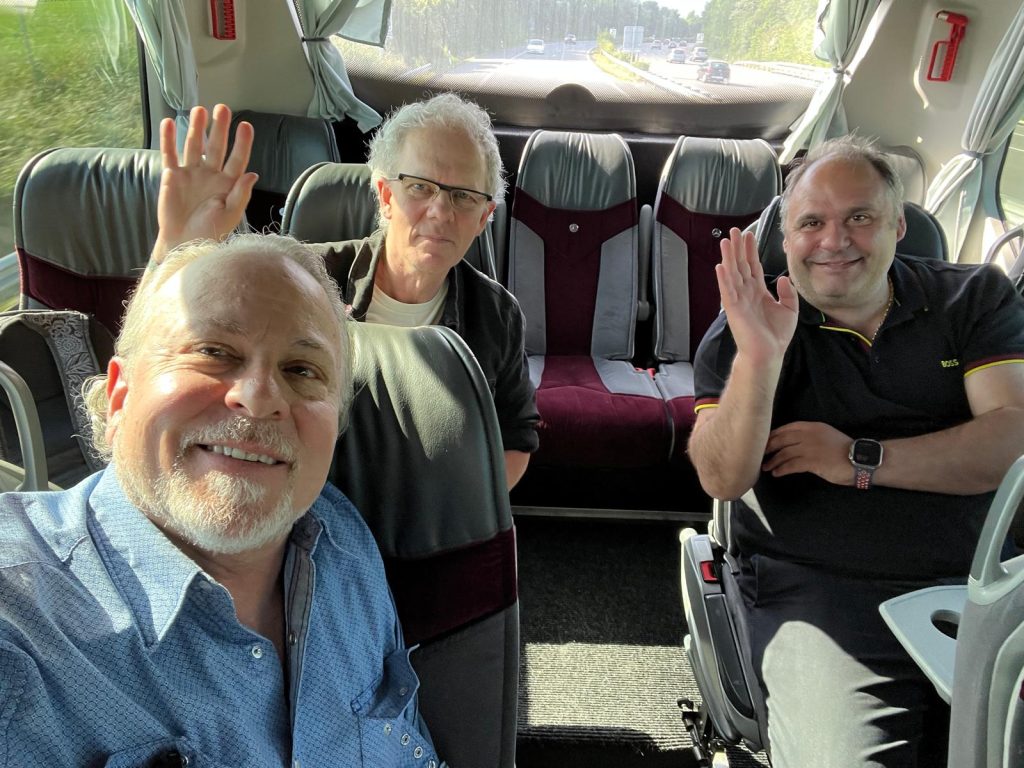
Classmates Hansjörg and Xavier, waving to the camera
As my Culture and Tourism course at the University of Geneva continues, our training has become more hands-on through immersive Geneva walking tours across different neighborhoods. These guided experiences are led by experienced members of the Geneva Guides Association, giving us a real-world model of high-quality Geneva guided tours and professional storytelling techniques from a Geneva professional tour guide perspective.
This week, we explored Carouge, a fascinating independent city within the Canton of Geneva. Originally founded in the 18th century under the Kingdom of Sardinia (the Savoyards), Carouge still feels like a small Italian-style city with its own identity, architecture, and rhythm.
Our tour was led by veteran guide and author Ariel-Pierre Haemmerlé, a respected Geneva professional tour guide who has written several books on local history, including “Le Vieux Carouge” (Alma Lux 2020). A resident of Carouge himself, Ariel combines historical expertise with civic engagement and strong storytelling skills.
We began at the Église Sainte-Croix, a landmark Catholic church built between 1777 and 1780 under Sardinian influence. Even though the church was closed for renovation, Ariel gave us a vivid introduction to its role as the heart of Carouge’s original urban plan designed to be a “rival city” to Geneva just across the river. The first written traces about Carouge date from 1247 and the first archeological traces include a bridge which dates from 1155. In 1816, Carouge and a part of it’s province (the ‘Communes réunies’) was joined to the canton of Geneva, but remained a separate city.
From there, the 1.5-hour walking tour took us through a mix of historic and modern highlights, including:
- Place du Marché
- hidden courtyards with microclimates and exotic plants
- home of Titeuf creator Zep (Philippe Chappuis)
- modernist residential towers, Tours de Carouge
- Le Vieux Carouge, oldest restaurant in Carouge
- Blavignac Fountain
- Cinéma Bio
- Église Réformée (Protestant church) at Place du Temple
What made this Geneva walking tour truly memorable was Ariel’s storytelling mixing architecture, anecdotes, and centuries of social history into a seamless narrative. He highlighted how Carouge evolved from a planned Sardinian town into a vibrant district of Switzerland, officially becoming part of Geneva in 1816, yet still proudly maintaining its own identity as its own “city”.
For me, the most fascinating part was hearing the human stories-how people lived, worked, and shaped Carouge’s culture over time. Ariel also brought a light sense of humour to the tour, making it both educational and genuinely fun.
This experience was a great reminder of what defines a high-quality Geneva guided tour: knowledge, storytelling, and personality. As I continue my journey toward becoming a Geneva Professional Tour Guide, guides like Ariel remain a strong source of inspiration.
FYI….You can find more information about Ariel’s book “Le Vieux Carouge” and/or purchase it at Payot
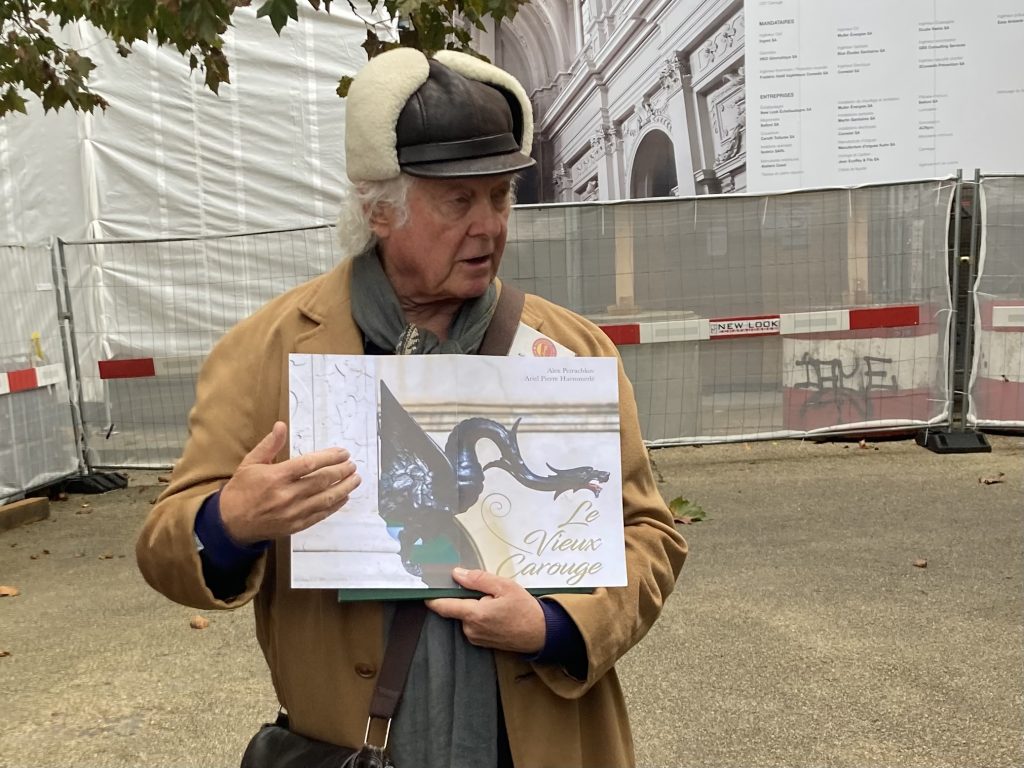
Ariel-Pierre Haemmerlé, Tour Guide, Author
The first month of my course at the University of Geneva has been wonderfully intense—in the best possible way. Between classroom lectures, museum visits, and immersive walking tours across different neighborhoods, every week has brought new discoveries. Learning directly from local experts while exploring the city has only deepened my appreciation for Geneva and strengthened my goal of becoming a Geneva professional tour guide.
Alongside the field outings, we’ve also had a steady rhythm of reading assignments, online quizzes, and our first major project. I’ve found myself genuinely fascinated by every topic so far—and even more excited about the idea of soon leading my own Geneva walking tours and Geneva guided tours.
One of the highlights of the month was an in-depth visit to Saint Peter’s Cathedral, one of the most iconic landmarks featured in Geneva guided tours. Following this visit, we were given a detailed assignment: to research the remarkable Maccabee Chapel, a richly decorated example of flamboyant Gothic architecture dating back to the early 15th century.
Our task was to create a four-minute narrated video tour (in French), as if we were guiding a group of visitors. The challenge was to present the chapel’s history, architecture, stained glass, decorative elements, and unique atmosphere in a clear, engaging, and professional way—just as we would during real-life Geneva walking tours.
To prepare, I spent several hours diving into books and online resources about Saint Peter’s Cathedral and the Maccabee Chapel. After writing and refining my script, I headed to the cathedral one afternoon to film the video. The goal wasn’t to produce a cinematic masterpiece, but rather to demonstrate the ability to deliver an accurate, engaging, and well-structured tour.
Filming turned out to be quite an experience! I recorded five takes using my iPhone in selfie mode, carefully navigating around groups of visitors. Timing was everything—I had to wait for quieter moments between tour groups to capture clear audio and maintain focus. Even though I’m fluent in French, presenting a full narration in a non-native language added an extra layer of challenge. Fortunately, with each take, I improved my delivery and confidence.
By the fifth attempt, I had a version that felt natural and engaging—good enough to submit for the assignment. If you’re curious, you can watch it here on YouTube.
I was thrilled to receive a high score on the project, which gave me a real boost of confidence for the next stages of the course. More importantly, the experience allowed me to gain a much deeper understanding of the history and atmosphere of Saint Peter’s Cathedral and the Maccabee Chapel—knowledge that I look forward to sharing in future Geneva guided walking tours.
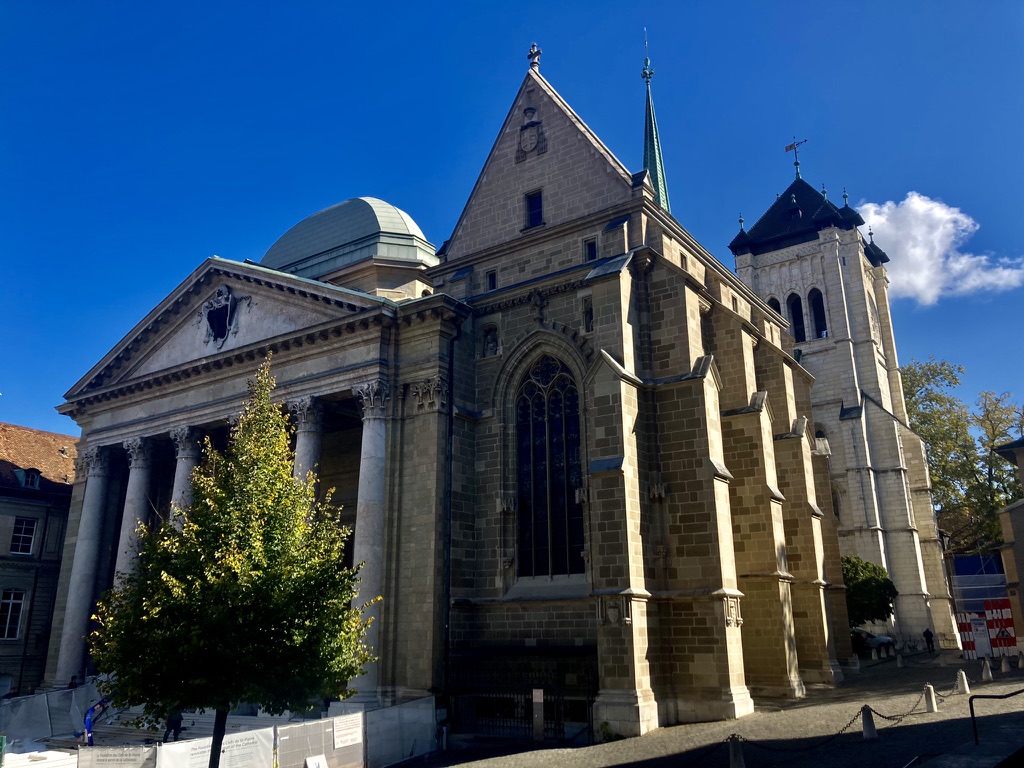
Geneva’s Saint Peter’s Cathedral and the Maccabee Chapel
Receiving my acceptance letter from the University of Geneva for the Culture and Tourism program in September felt like a huge win for me. After some time away from academic life, I was genuinely thrilled to get back into the classroom—ready for fresh ideas, new perspectives, and plenty of intellectual stimulation. Honestly, I felt like a kid again on the first day of school.
The program structure was perfect: two weekends per month, blending classroom learning with hands-on fieldwork over the course of a year. For anyone aiming to become a Geneva professional tour guide, this kind of immersive training is what is needed.
Saturday morning September 14th kicked off at Uni Mail, bright and early at 9am. I arrived a little ahead of time (tour guide habit!) and was delighted to find coffee and biscuits waiting—always a good sign. After grabbing a coffee, I introduced myself to the Director of the Culture and Tourism program, Anna Hamilton, and shared how excited I was to be part of the class.
Soon after, I began meeting my fellow students. One of the first people I spoke with was Philippe Ruegg, a Geneva-based architect and urbanist. We instantly connected over our shared professional backgrounds and enthusiasm for the course. Before long, the room filled up, and right on time, Anna officially welcomed us to what would become an unforgettable journey.
Our first lecture was led by Professor Irène Herrmann, a historian from the University of Geneva’s Faculty of Humanities. She introduced a powerful guiding question—the “red thread” of the program:
“Why did a small town, once a Roman outpost, become one of the world’s most important international cities?”
From there, we were taken on a fascinating journey through six key periods in Geneva’s history, from the 11th to the 20th century. It was exactly the kind of storytelling depth that makes Geneva walking tours so captivating.
The day continued with a series of engaging lectures from historians, architects, and local experts. By the end of Saturday, I was already seeing Geneva through a new lens—one that I knew would enrich my future Geneva guided tours.
But Sunday was where things really came to life.
We stepped out of the classroom and into the city itself, joining guided tours led by experienced professionals. Our first was a classic two-hour Geneva city tour with Cyrille Wohlschlag, a seasoned professional Geneva tour guide and historian with over 20 years of experience.
Starting at the Brunswick Monument and ending at the Reformation Wall, we explored some of Geneva’s most iconic landmarks. This was my first time observing a Geneva professional tour guide in action—and it did not disappoint.
Cyrille’s storytelling was clear, engaging, and full of fascinating historical details. His sense of humor and well-placed anecdotes kept everyone hooked from start to finish. The two hours flew by, which is always the sign of a great tour.
By the end of the day, one thing was crystal clear: I didn’t just want to learn about Geneva—I wanted to bring it to life for others through my own Geneva walking tours.
And just like that, the journey continued.
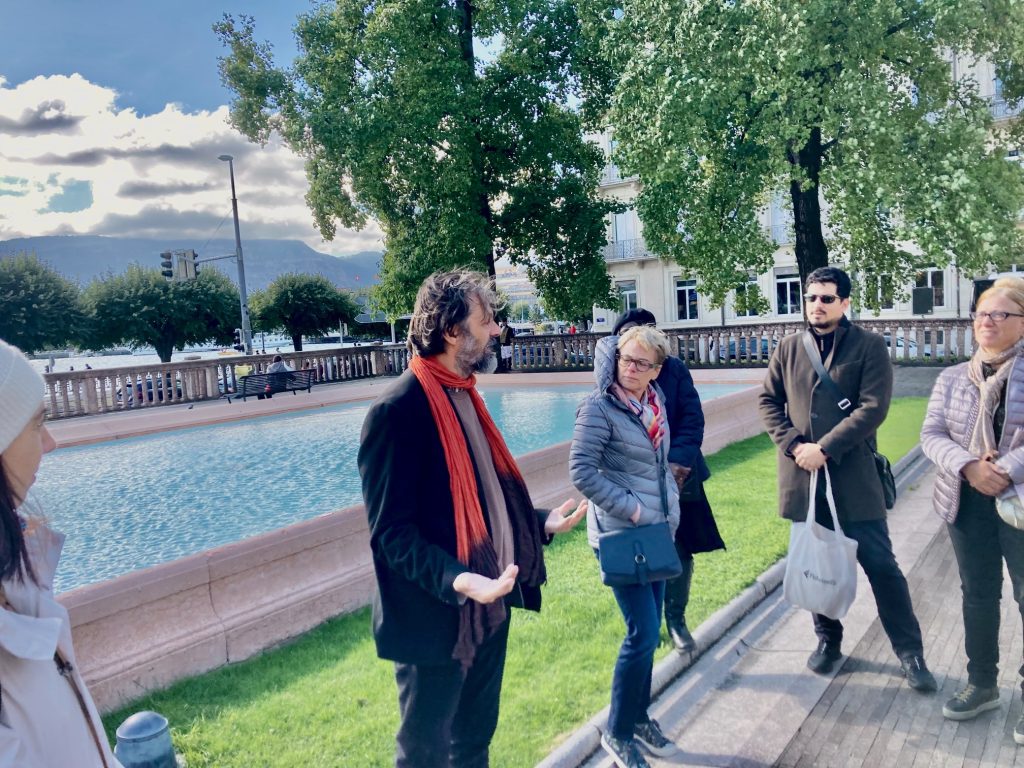
Cyrille Wohlschlag, Geneva Tour Guide/Historian
After my meeting with Marilynn Geiger, I decided to explore the University of Geneva’s course catalogue. Before long, I found a webpage dedicated to the Culture and Tourism certificate program that was scheduled to begin in September 2024. As someone hoping to eventually lead Geneva walking tours and Geneva guided tours, the program was perfectly in line with my aspirations.
The description of the one-year course sounded fascinating, and it quickly became clear to me that enrolling in the program would be an important step toward my goal of becoming a Geneva professional tour guide.
Marilynn had explained something interesting about the tour guide profession in Switzerland. Technically, there are no laws or regulations that prevent someone from becoming a tour guide. In other words, anyone can show up and start offering walking tours of Geneva. However, there is an important difference between simply giving tours and working as a certified tour guide or Swiss professional tour guide.
To become a member of the Geneva Guides Association and to work with the Geneva Tourism & Congress Foundation, obtaining the certificate from the University of Geneva is essential. While some people offer tours without training or certification, they generally do not work at the same professional level — or receive the same remuneration — as trained and certified guides.
Another reason the program appealed to me was the depth of the curriculum. The University of Geneva course includes in-depth studies of Geneva’s history, architecture, art, heritage, and culture. For anyone hoping to lead high-quality Geneva guided tours, this kind of knowledge is invaluable.
Even better, the program also includes practical training. Students learn how to conduct Geneva walking tours as well as practice guiding techniques, and learn how to guide excursions by bus to important cultural and historical sites throughout the Geneva region. In other words, it’s not just about reading books — it’s about learning how to actually guide visitors and bring Geneva’s story to life.
Convinced that this program was the right way to begin my journey toward becoming a Geneva professional tour guide, I decided to contact the program director, Anna Hamilton. We arranged a telephone conversation, and she kindly explained the structure of the course, the subjects covered, and the examination process.
Anna also told me about the many past participants who successfully completed the program and are currently working as professional guides in Geneva. That was certainly encouraging news for someone hoping to become a certified tour guide in the city.
Additionally, Anna told me that the entire course would be taught in French, and advised that a minimum B2 level in spoken and written French would be necessary to keep up with the coursework. Fortunately, after many years living in Switzerland and studying French, I knew this would be no problem for me. Anna also mentioned that most people who take the course and go on to become tour guides speak a minimum of three languages. Since I also speak fluent Spanish, I knew that this would not be an issue.
Finally, Anna added one last piece of advice: if I wanted to join the program, I needed to move quickly. The application deadline was in June.
So that’s exactly what I did.
Immediately after our call, I began filling out the application, which required both a CV and a motivational letter. The journey toward becoming a Swiss professional tour guide was progressing.
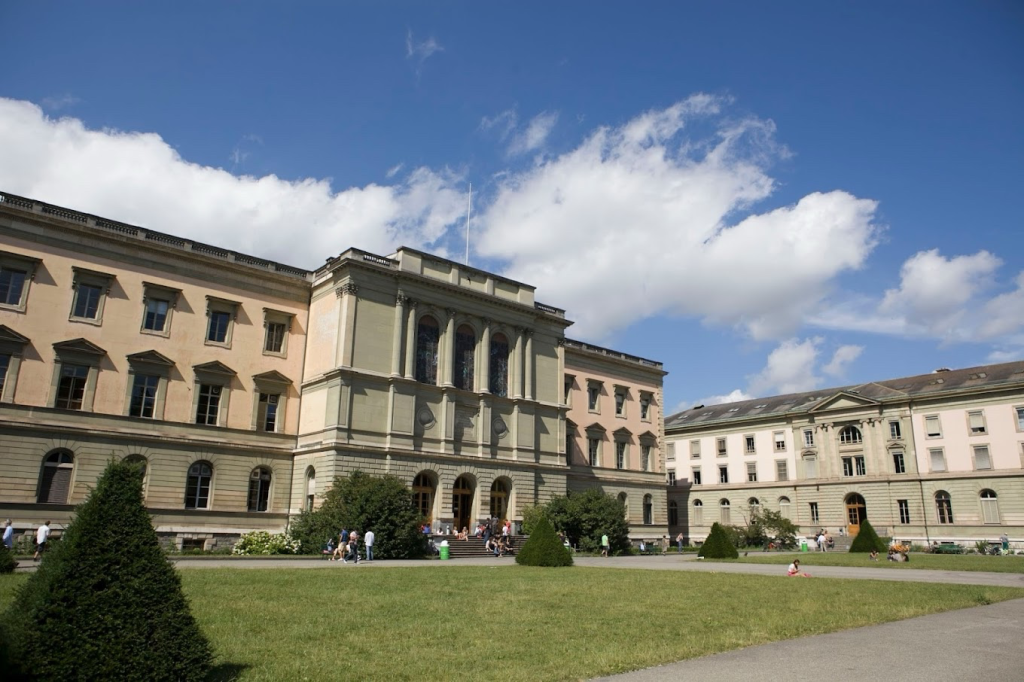
University of Geneva, UNI Bastions – built 1868